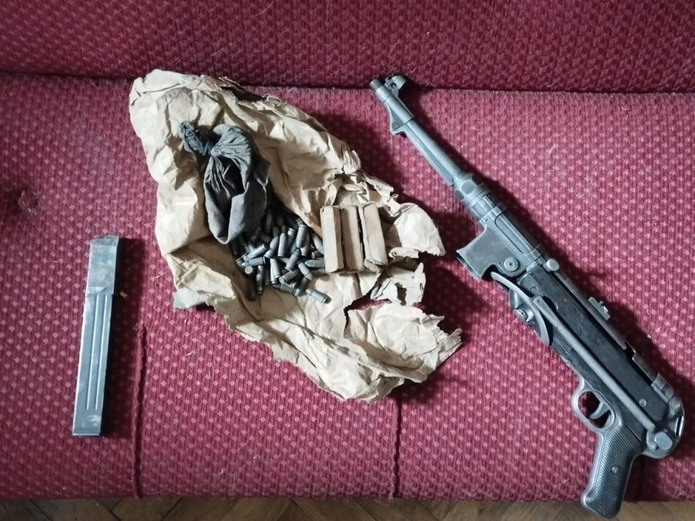
During structural dismantling and roof renovations in the historic Old Town quarter of Tarnów, Lesser Poland (Małopolska), construction workers uncovered an intact World War II German Maschinenpistole 40 (MP 40) submachine gun.
Wrapped in protective cloth rags and concealed inside a wooden roof frame, the 9×19mm Parabellum firearm was discovered alongside its 32-round box magazine and tarnished 9mm ammunition packets hidden in nearby rafters. Regional officers from the Małopolska Police (Policja) secured the historical artifact and initiated evaluation protocols to transfer the submachine gun to a regional museum catalog rather than executing destruction orders.
1. Tactical Incident & Ordnance Profile

- Discovery Location: Old Town Tenements, Tarnów, Lesser Poland Voivodeship (Województwo Małopolskie), Poland
- Discovery Context: Roof structural disassembly and rafter clearance during residential building renovation
- Weapon Model: Maschinenpistole 40 (MP 40)
- Manufacturing Date: 1941 (Stamped receiver code)
- Caliber / Action: 9×19mm Parabellum | Open-bolt, blowback selective-fire / automatic
- Associated Items: 1 × 32-round steel box magazine | Multiple paper/cardboard-wrapped packets of tarnished 9mm Parabellum munitions
- Conservation State: High structural integrity; rag wrapping prevented severe oxidation to the stamped steel receiver, folding stock, and Bakelite/synthetic handguards.
- Current Status: Secured by Małopolska Policja; slated for institutional preservation and transfer to a Polish military museum.
2. Historical Context & Provenance Analysis

[1941 German Military Production] ──► [WWII Underground Resistance / Partisan Caching] ──► [Eight-Decade Rafter Encapsulation] ──► [Old Town Roof Renovation Discovery] ──► [Police Clearance & Museum Acquisition]- The Occupation of Tarnów (1939–1945): Occupied by Wehrmacht forces in September 1939, Tarnów became a primary administrative and industrial node in the Generalgouvernement. The city’s substantial pre-war Jewish population was forced into the Tarnów Ghetto before mass deportations to Belzec and Auschwitz-Birkenau extermination camps.
- Underground Resistance & Arms Stockpiling: Armed resistance in Tarnów was actively maintained by both the Polish Home Army (Armia Krajowa) and Jewish underground partisan cells operating within the ghetto and surrounding forests. Concealing automatic weapons like the MP 40 in attic rafters and roof trusses of dense urban tenements provided immediate access for urban guerilla actions while evading routine house-to-house searches by Gestapo and Ordnungspolizei units.
- Attic Preservation Environment: Encapsulating the firearm in dry textile wrappings within high-altitude, unheated roof rafters sheltered the steel and spring components from water ingress, slowing chemical degradation across 80+ years of storage.
3. MP 40 System Specifications
| Parameter | Technical Details |
| Weapon Designation: | Maschinenpistole 40 (MP 40) |
| Primary Material: | Stamped sheet steel receiver, folded steel under-folding stock, synthetic (Bakelite) lower frame |
| Rate of Fire: | ~500 rounds per minute |
| Muzzle Velocity: | ~400 m/s (1,312 ft/s) |
| Feed System: | 32-round detachable box magazine |
| Historical Significance: | Standard-issue submachine gun of the German Wehrmacht, heavily captured and redeployed by Allied and partisan forces across occupied Europe. |
