
At the junction of the A2070 near the village of Hamstreet in Romney Marsh, Kent, stands a modest memorial commemorating the crash of a Boeing B-17G Flying Fortress – and the death of its pilot, Lt William H Johnson. The US Stars and Stripes flag flies permanently at the site, which is visited by many people and looked after by a small group of locals. As with many other crash locations in the UK, each has its own unique story; this one began in the summer of 1943 at Harvard Air Base, Nebraska.
Preparing for war
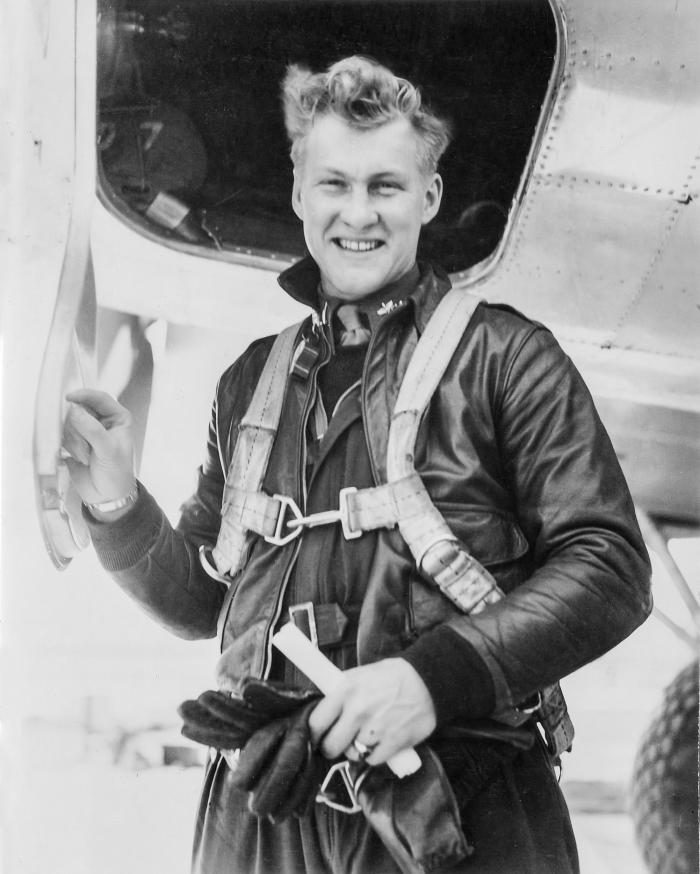
Lieutenant Johnson graduated from Washburn High School and joined the United States Army Air Forces (USAAF) in August 1942. He formed Crew 57 in Nebraska during July 1943 and had been taking every opportunity to fly in B-17s whenever he could find a willing co-pilot, regulations dictating that the aircraft needed to have at least two crew members on board for each flight. So, when left waist gunner Staff Sergeant (SSgt) Kenneth A Zeiger arrived at the base, the first to join the new crew, he was delighted when Lt Johnson asked him to act as ‘unofficial’ co-pilot.
Zeiger quickly learnt what to do in case of an emergency in combat, becoming familiar with the controls after just ten hours’ flying time. On one such flight, Johnson had to use the facilities and, leaving the pilot’s seat, the terrified staff sergeant remained at the controls.

After around 30 hours’ flying time with Johnson, Zeiger was tested on his observations of landing procedures. Shortly afterwards, the pilot asked him to enter the landing pattern and land the B-17G, an even greater shock for the waist gunner, but he tried three attempts to make a decent ‘touch and go’ – fortunately, Johnson took control as the wheels finally touched down. By the time the other new crew members arrived, Kenneth Zeiger had flown a B-17G for 40 hours!
The airmen who reached Harvard Air Base to join Johnson were: co-pilot Lt Harold Whiteley, navigator Lt William Fancher, bombardier Lt George Nye, radio operator/gunner Sgt John Higgins, right waist gunner Sgt Elbert Williams, tail gunner Sgt Peter Bartkus, engineer/gunner Sgt Frank Hazzard and ball turret gunner Sgt Paul Simpson. Crew 57 prepared to fly its assigned B-17G, 42-31161, across the Atlantic to join the 711th Bomb Squadron (BS) of the 447th Bomb Group (BG), Eighth Air Force, at Rattlesden, Suffolk. They were following in the footsteps of many other crews who left their homes to fight over Europe – sadly, many of them would never return.

After taking off from Harvard, they stopped at Baer Field in Fort Wayne, Indiana, before reaching Syracuse, New York. There, Johnson flew over Lt Fancher’s home and later circled above Lt Whiteley’s house in Limerick, Maine. The last stopover was Gander Lake, Newfoundland, but they had to wait there for three days due to poor weather before crossing the Atlantic and arriving at Belfast, Northern Ireland – an estimated 12-hour flight.
Arrival in England
They touched down in dense fog, landing safely, remaining at Belfast for two days before the onward flight to Rattlesden.
The 447th BG had been heavily engaged in missions from the Suffolk base since December 23, 1943. The unit’s main role was to weaken German defences, preparing the ground for the invasion planned for 1944. Rattlesden had been given over to the USAAF on October 1, 1942; the 322nd BG from Rougham, Suffolk, with its B-26 Marauders, occupied Rattlesden and its tenure continued until April 1943. The 447th BG, whose B-17Gs displayed a large K in a square, then arrived from the US at the end of November 1943.

After Crew 57 reached their new home, they quickly settled in, preparing for a first mission over enemy territory. This took place on December 30, 1943, the target being a chemical factory at Ludwigshafen. The crew retained B-17 42-31161, but christened her Spare Parts. This was because certain items had been removed from the aircraft and not recorded by the guilty party in the aircraft’s logbook – a practice Johnson soon put a stop to.
Crew 57 flew together on no fewer than 21 missions. On April 11, 1944, Spare Parts sustained damage on return from Arnimswalde, Poland, the longest raid they took part in. Aside from heavy flak over the target, they encountered Messerschmitt Bf 110s and Me 210s over Germany and the Baltic Sea.
The damage to their Flying Fortress was sufficient for it to be returned to the hangar for intensive repairs.
A sense of unease
While the works were being undertaken, the Crew 57 members were not idle – they were immediately assigned another aircraft, 42-31719. When their former charge returned from the workshop it was flown by a new crew, in whose care it sadly crashed. Spare Parts was broken up and various sections were salvaged; it had indeed lived up to its name.
Crew 57 would never fly its original machine again and the superstitious among the crew took this to be a bad sign. Feeling less than comfortable, they undertook Mission 22 on April 13 – a raid on the Messerschmitt factory at Augsburg, Germany. There were various setbacks before the flight even got under way, doubtless fuelling the crew’s sense of trepidation.
Johnson and his crew got up early as usual, had breakfast and then went to the briefing before moving on to the hangar to check on B-17G 42-31719. Before any mission, Sgt Bartkus would check the guns – on this occasion he unfortunately charged one of them and pressed the trigger. Two shots were fired, narrowly missing a passing fuel bowser. One shell was an incendiary – had it hit the tanker it would almost certainly have killed and injured several crew and ground staff.

The fact that it was the 13th of the month added to the feeling of impending doom. In a bid to compensate for this, the crew decided their best option was to paint the name Spare Parts on to the new machine. What seemed like a comforting idea did not come to fruition. Despite their best efforts, the paint would not dry properly as it was raining when the B-17 was taken out of the hangar – yet another bad omen.
Another oddity was Johnson’s decision to smoke a cigarette before the mission. Johnson was not a habitual smoker, and the sight of him doing so while he spoke to each member of the crew may have unnerved them even more. Did he have a premonition about the flight? Despite these concerns and setbacks, Crew 57 took off from Rattlesden and joined the large formation transiting the Channel.
Over Abbeville
When over Ostend and Dunkirk, they encountered flak for at least 90 miles inland. Soon the B-17G was surrounded by black puffs of smoke. Co-pilot Lt Whiteley noticed that number four engine had stopped and that number three engine was running rough. Johnson decided to head for home, flying in a straight line over flak areas, Abbeville being the worst.
At around 23,000ft, the aircraft was hit. Both number one and two engines were still running, but the bomber was descending at 500ft per minute. Having already left the comparative safely of the bomber formation, Crew 57 now prepared for the worst. Johnson needed to make the stricken aircraft as light as possible – he ordered Sgt Williams to dump all loose items and to prepare to drop the ball turret.
Sgt Hazzard recalled: “About this time, the co-pilot called and asked me to transfer the fuel from number four engine to number one engine. This done, I proceeded to throw all my ammunition boxes, flak helmet and other moveable equipment out of the aircraft to lighten the load. I went to the nose and did the same thing there.”

They then dropped their bombs. Zeiger was told to stay on the intercom; when needed he helped Higgins, Simpson and Williams to release the ball turret. This proved a hazardous business – two of them nearly fell with it as the bomber instantly raised itself, shed suddenly of so much weight.
Looking through the empty hole, Abbeville was ablaze below – but then the damaged aircraft was hit again by flak. Lt Nye, the bombardier, was hit in the arm. Navigator Lt Fancher continued to keep the doomed bomber on course, despite a hole in his thigh. Whiteley suffered a hand injury. Despite severe damage to cables, Johnson kept the B-17 airborne for as long as possible. Number two engine was still running, albeit roughly, and although number one was still running well, fuel levels were low as they crossed the Channel. It was not possible to transfer fuel as the electric pump was damaged.

At 12,000ft and with only one good engine, Crew 57 prepared to ditch in the sea. Air Sea Rescue was notified, and it was not long before a launch could be seen, a comforting sight perhaps as the aircraft lumbered across the English coastline, now flying at just 2,000ft.
Final moments
Just then, number two engine failed and caught fire, and the aircraft’s damaged left tailplane broke away. Johnson now gave the order to bale out – their valiant attempt to get the aircraft home had ended. As leader, Johnson had told his crew that if ever they had to abandon their aircraft, he would be the last to jump. It remained his intention to stay with the bomber until every man in the crew had jumped clear.
Crossing the coast over Romney Marsh, the crew – except Johnson – parachuted, landing uninjured in the vicinity of Snave Corner, near Hamstreet. Still at the controls, Johnson circled the area looking for a suitable place to crash-land. The plight of the lumbering aircraft was witnessed by Jeff Jordon, along with his father and younger brother Brian, who were at Warehorne, a Kent village overlooking fields in the area.

As the aircraft circled, they watched as a flare was fired by Johnson, indicating that he was going to put down. They looked on in horror as the giant bomber came in, apparently to land, but then luck ran out and the aircraft struck the ground at Ham Hill Farm. It disintegrated, killing its brave pilot instantly.
Having prioritised the survival of his colleagues, Lt William H Johnson was posthumously awarded the Purple Heart, Air Medal and the Distinguished Service Cross. In a tragic twist, Johnson’s final mission was his 25th of the war – had he survived he would have returned to the US and his family.
The return
In 1992, Kenneth Zeiger and his wife returned to England and visited Rattlesden airfield, which has a magnificent memorial by the roadside dedicated to the 447th BG.

He made another trip to his old base in 1995, and also visited the crash site that claimed the life of Lt Johnson. Zeiger also looked in at the museum at Brenzett (today known as the Romney Marsh Wartime Collection) where there is a display in memory of the crash. Brian Jordon, who witnessed the tragic event back in 1944, has presented the museum with a painting he did of the B-17 with one engine on fire, flying over Hamstreet.

In the 1990s, the village of Hamstreet finally got a bypass, and during its construction a new road junction was formed near the site of the 1944 B-17 crash. A memorial was erected at Hamstreet in April 1994, and a smaller memorial was placed in the garden of Mrs J Goddard, who lived in the house closest to the crash site.
And the new road junction? It was named Johnson’s Corner, in remembrance of a brave airman.