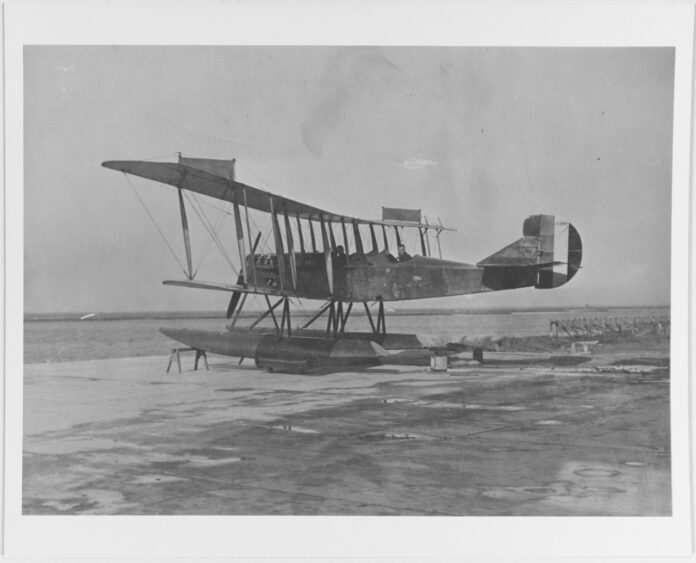
When looking back at the birth of American naval aviation, few locations carry as much coastal defense legacy as New Jersey. At the heart of this legacy sits an iconic archival photograph from 1918 (Catalog #: NH 60782), capturing a Curtiss R-6 (Bureau Number A-190) resting at Naval Air Station (NAS) Cape May [NH 60782]. This single image documents a historic milestone: the very first aircraft flight executed from the station. [NH 60782]
Historical Overview
| Attribute | Details |
|---|---|
| Aircraft Model | Curtiss R-6 Seaplane |
| Bureau Number (BuNo) | A-190 |
| Location | Naval Air Station Cape May, New Jersey |
| Year of First Flight | 1918 [NH 60782] |
| Archival Source | Naval History and Heritage Command [NH 60782] |
The Pioneer of Coastal Patrols
As the United States entered World War I, protecting the Atlantic coastline from German U-boats became an urgent priority. NAS Cape May was rapidly established to guard the strategic entrance to the Delaware Bay.
To kickstart operations, the Navy deployed the Curtiss R-6, a twin-float seaplane built specifically for long-range scouting and training. Powered by a Curtiss Model OXX engine, the R-6 was a two-seat biplane capable of carrying light bombs or depth charges. When BuNo A-190 lifted off from the Cape May waters in 1918, it formally launched a century-long tradition of maritime surveillance in the region [NH 60782].
Technical Specifications of the Curtiss R-6
| Specification | Metric / Detail |
|---|---|
| Crew | 2 (Pilot and Observer/Gunner) |
| Propulsion | 1 × Curtiss V-2-3 rated at 200 hp (or OXX variants) |
| Configuration | Twin-float biplane |
| Primary Role | Anti-submarine patrol & flight training |
| Armament Capabilities | Light bombs or experimental radio equipment |
A Lasting Legacy
While the Curtiss R-6 was eventually phased out by more advanced flying boats like the Curtiss HS-2L, its successful deployment at Cape May proved the validity of coastal air stations.
The site itself underwent massive changes over the decades, transitioning from a wartime Navy base to its current status as the United States Coast Guard Training Center Cape May—the sole accession point for all enlisted Coast Guard recruits. Today, the pioneering spirit of BuNo A-190 is still honored by local historians and aviation museums, serving as a reminder of the brave pilots who first took to the Jersey skies.