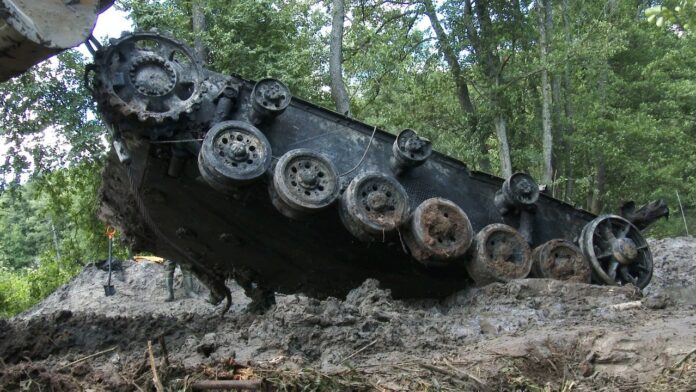
Explorers have discovered the wreck of a German World War II assault gun in Masuria, Poland, with a man from Poznań among the team. The remarkable discovery was made on Friday, July 5, when they recovered the remains of a German StuG III assault gun from the Miłakówka River. They also found the roof of a Jagdpanther tank destroyer, an exceptionally rare vehicle from the same period. According to the explorers, discoveries of this kind happen only once every few years.
The remains of the German military vehicles were recovered near the town of Orneta, in the Masuria region. Local residents had pointed the explorers toward a location where the wrecks might be found, and their information proved correct: the Miłakówka River concealed some extraordinarily rare discoveries.
“During the war, this was the Sportyny bridgehead. Fierce fighting took place here, including battles involving armored vehicles. Remains of a bridge can still be found at this location,” explained Mateusz Deling, one of the expedition’s main organizers and owner of the Museum of Military Technology and Pomeranian History in Kłanino. A passionate history enthusiast, Deling works professionally in the hotel industry.
The Miłakówka River is relatively shallow. Everything suggests that German forces attempted to cross it in 1945, but the operation failed and the vehicles sank. Some of the vehicles were subsequently recovered, while others were left behind after being blown up.
What the explorers managed to bring to the surface filled them with excitement.
“We began the recovery operation on Thursday evening. Using an excavator, we almost immediately pulled out a very large piece of metal. Mateusz ran over to it and recognized it straight away. It was the roof of a German Jagdpanther tank destroyer,” recalled Przemysław Budzich, a Poznań native who documented the expedition. He works as a journalist for Winogradzka Cable Television and documents exploration projects in his spare time. He also runs the YouTube channel Tank Hunter, which focuses on searching for military vehicles from World War II.
After recovering the Jagdpanther roof, the team turned its attention to an even larger and better-preserved find. Recovery operations began early Friday morning, with two excavators, a tracked technical recovery vehicle, and a MAN engineering vehicle available to assist.
After several hours of difficult work, the remarkably well-preserved chassis of a StuG III assault gun emerged from the river. The vehicle weighs between 10 and 12 tons and measures approximately seven meters in length.
“The biggest challenge was the water constantly flowing over the site. The entire operation was carried out underwater; we did not drain the area before the recovery. I personally dived down and tried to attach the hooks. Eventually, we succeeded and were able to begin pulling it out,” Deling explained.
Just how rare was this discovery? Finds of this kind are recovered only once every few years.
A similar German assault gun was recovered near Poznań in 2008. However, Deling emphasized that the newly recovered vehicle is genuinely unique because of its condition, with approximately 40–50 percent of the original structure preserved.
While the StuG III is a rare discovery, the Jagdpanther component could be described as “ultra-rare.” Only 382 Jagdpanther tank destroyers were manufactured, and just 18 were reportedly sent to the Eastern Front.
“The excitement was enormous because you don’t see explorations like this every day,” Budzich stressed.
There are relatively few World War II armored vehicle wrecks left in Poland. Many were cleared away during the 1950s and 1960s. Explorers receive numerous reports of potential wreck sites, but many turn out to be false leads or nothing more than local legends.
In this case, however, the evidence was tangible. The expedition members even discovered a kayaking guidebook from the 1960s that instructed readers to keep to the left side of the river because parts of a German tank lay on the right. A German helmet was also found in the Miłakówka River.
But the story does not end with the recovery. The StuG III now faces a lengthy restoration process.
Although its engine and gearbox were still inside, both had been damaged by an explosion and were no longer usable. The team is currently awaiting a decision from the heritage conservation authorities on whether the vehicle can be placed on deposit at the Museum of Military Technology and Pomeranian History in Kłanino.
Once permission is granted, restoration work can begin.
Parts will have to be sourced from various places, and the project could prove extremely expensive. Deling estimates that rebuilding the vehicle will take between one and two years.