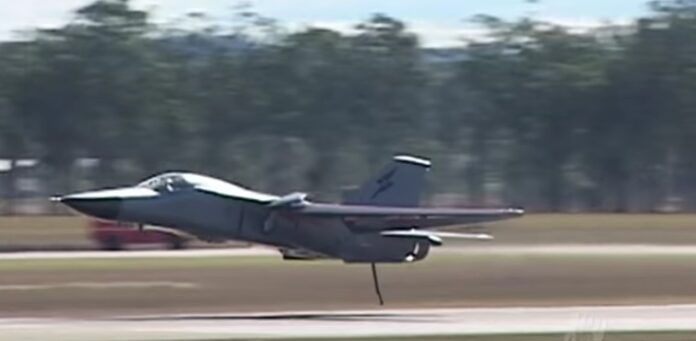
The aircraft involved in the incident, which actually happened on Jul. 18, 2006, was the F-111C A8-143.
Noteworthy the reason behind the incident was the loss of the plane’s port main wheel shortly after take-off.
According to The Sydney Morning Herald, once the tower alerted the F-111 aircrew members, that were Flying Officer Peter Komar (a rookie pilot) and Flight Lieutenant Luke Warner (an experienced Navigator), about the missing wheel and after a two-hour period of planning, involving them dumping fuel in nearby Moreton Bay, they were told to attempt a belly landing.
As the F-111 aircrew explains in the footage, as their disabled jet came down, they lowered the aircraft tailhook which picked up a cable that helped bring it to a halt, creating a plume of sparks as it slid on its belly along the tarmac.
F-111 CA8-143 was delivered to RAAF on Sep. 6, 1973 and was modified to RF-111C reconnaissance standard in 1980. After the belly landing the aircraft had never been repaired and its fin and rudder are preserved at RAAF Base Amberley.

RAAF F-111s
The story of the RAAF F-111s is quite interesting.
The Australian Government purchased 24 F-111Cs in 1963. These were completed during 1968 and early 1969, and the first of the RAAF’s aircraft was handed over to the service on Sept. 4 1968. However, the entire fleet was grounded in the U.S. shortly afterwards while serious deficiencies with the F-111’s design were corrected. The RAAF finally accepted the 24 aircraft during 1973, and they flew to Australia in four groups between Jun. 1 and 4 Dec. 4 that year.
Four of the F-111Cs were modified to RF-111C reconnaissance aircraft. The first, A8-126, received these modifications in the U.S. between Oct. 1979 and Apr. 1979; the other three were converted in Australia between Jul. and Sep. 1980.
The RAAF purchased four ex-U.S. Air Force (USAF) F-111As in 1981 as attrition replacements. These aircraft were delivered to the service in 1982 and were subsequently converted to F-111C standard.
In 1992 the Australian Government decided to purchase up to 18 ex-USAF F-111Gs in order to extend the type’s service life. 15 F-111Gs were eventually acquired, and they were delivered to the RAAF during late 1993 and early 1994. Three more ex-USAF F-111Gs were also held for Australia in the U.S., but never delivered.
The RAAF retired the F-111 fleet on Dec. 3 2010. Eight of the service F-111s (seven F-111Cs and one F-111G) were destroyed in crashes during the type’s service, with ten airmen being killed.