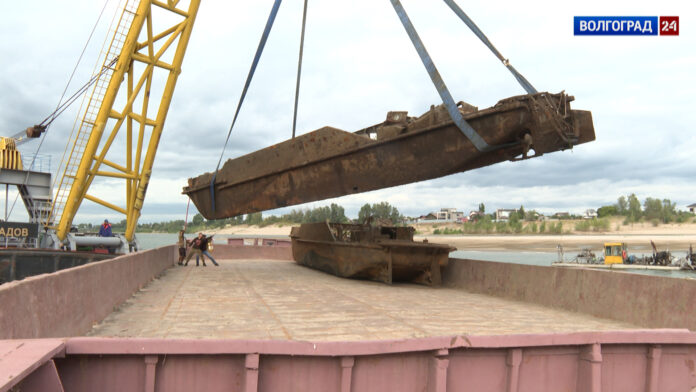
A unique operation has taken place in the waters of the Volga River in Volgograd: two vessels that participated in the Battle of Stalingrad have been raised from the riverbed. They turned out to be rare self-propelled pontoons, both believed to have been sunk by enemy shells. The two vessels had been coupled together and lay on the riverbed for an astonishing 83 years. It has already been announced that these sunken artifacts will be restored. For now, members of the regional prosecutor’s search team are examining the vessels.
Photos: Vadim Shabanov, Alexander Pishchalko
The Volga is choppy, and the wind stings people’s faces. Dozens of people are preparing for a crucial and challenging operation: ship crews, lifting and mooring teams, and search specialists. Opportunities to come so close to history are rare. The first self-propelled pontoon from the Great Patriotic War—the Soviet term for the Second World War—has already been brought up from a depth of six metres. The operation must now be repeated, as another identical vessel is waiting on the riverbed.
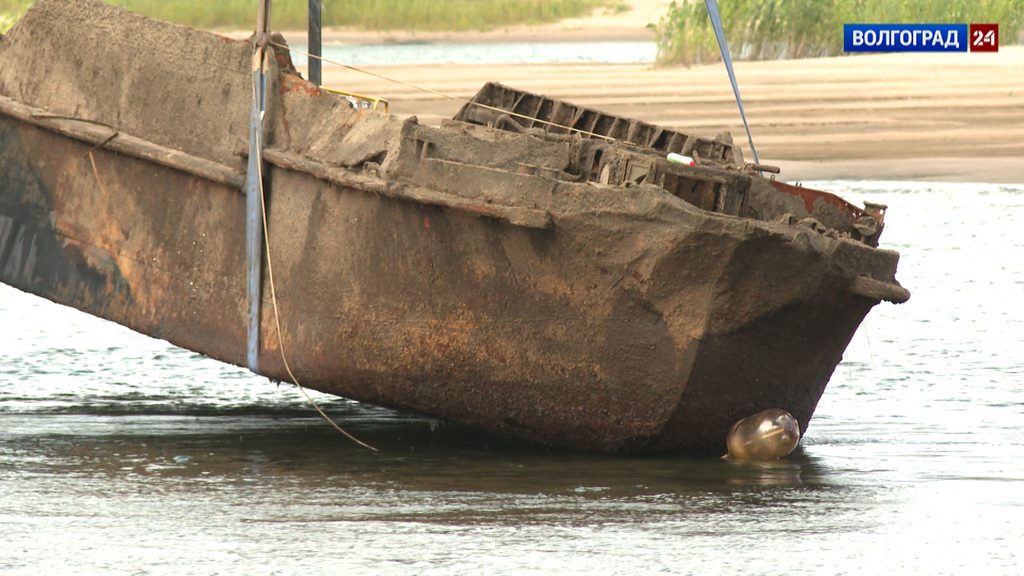
Here it is: a truly historic moment as a self-propelled pontoon breaks free from the surface of the Volga River. This silent witness to the Battle of Stalingrad has lain beneath the river for 83 years.
With no sudden movements, the team carefully guides the multi-tonne discovery toward a cargo vessel, while gusting winds make the lifting operation even more difficult. The pontoons must be positioned precisely to distribute the load evenly across the vessel’s sides, bow and stern. Rashid Khansvyarov coordinates the floating crane’s movements from the deck.
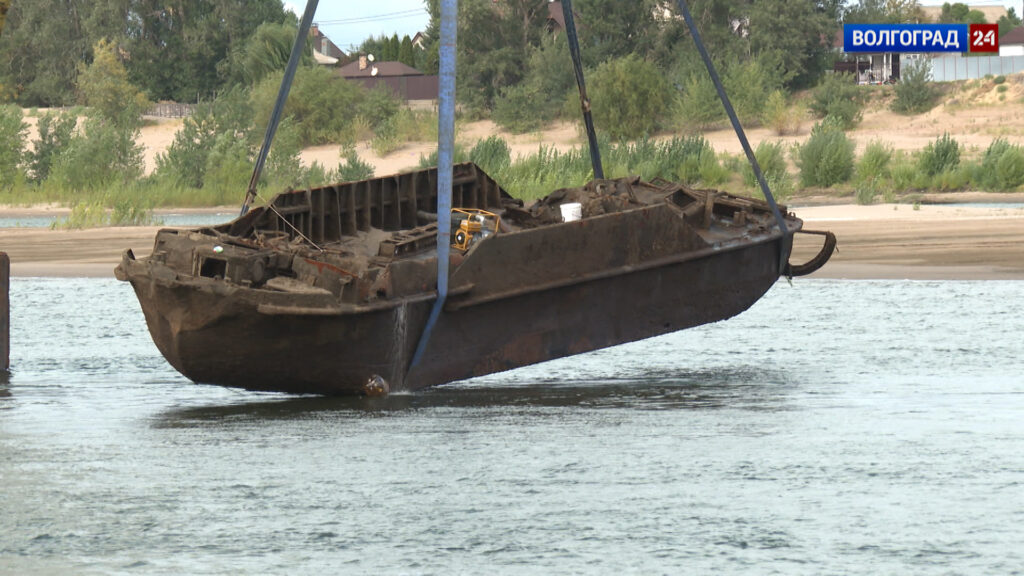
The enormous metal structure must be lowered as gently as possible. Explosive remnants may still be inside its compartments. During the Battle of Stalingrad, vessels of this kind helped supply the Soviet forces fighting in the city, transporting enormous quantities of weapons and ammunition. Only now can the team finally breathe a sigh of relief.
“We had dreamed of this for a very long time. Everything went smoothly in the end, but it was a difficult and extensive operation. Things kept going wrong: we would clear away the sand, only for the current to cover everything again; then something else would happen. The water level was too low for the crane to get in. And then, suddenly, everything came together. I want to highlight the professionalism of the fleet captains, because everything was accomplished without a single problem,” said Rashid Khansvyarov, coordinator of the recovery operation.
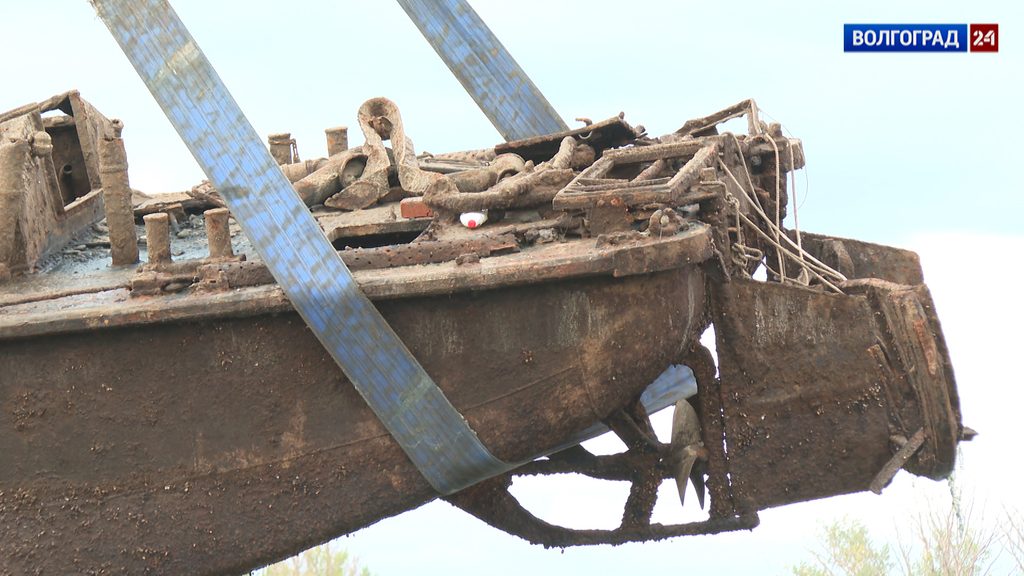
Divers discovered the artifacts several years ago. Strong currents had covered the vessels with silt, and experts were able to identify their type only by examining individual fragments. They turned out to be self-propelled pontoons belonging to the SP-19 pontoon park. During the Battle of Stalingrad, numerous boats of this type were used to create crossings for transporting supplies.
“They were moored to one another, joined side by side as a paired unit. Most likely, they were used in this configuration to accommodate a larger cargo capacity. It is also possible that their engines were not operational, although it is difficult to say at this stage,” noted Denis Kostenko, prosecutor of the Volgograd Region and head of the search team named after S. V. Bekedov, a prosecutor of the Stalingrad Region.
What is known, however, is the crucial role played by the heroic crews of these pontoons during the Battle of Stalingrad. Dozens of such structures were connected to form bridges and crossings, allowing troops, military equipment and provisions to be transported across the river. In the summer of 1942, on the Don River, the actions of river crews helped delay German forces advancing toward the city. After the Soviet withdrawal, the pontoons were transferred to the Volga, where they arrived at a decisive moment in the battle.
“I can say that the crossing of the legendary 13th Guards Rifle Division was carried out with the assistance of self-propelled pontoons. Transporting 10,000 people in just two nights was an enormous operation. Gunboats, as well as ordinary civilian steamships and barges fitted with guns, generally had limited carrying capacity,” explained Svetlana Argastseva, head of the exhibition department at the Battle of Stalingrad Museum-Reserve.
All of this took place under relentless enemy air and artillery fire, and the losses were enormous. Remarkably, the interiors of the vessels have survived well despite eight decades of submersion.
Specialists have noted the excellent preservation of many of the vessels’ components. In the wheelhouse, for example, the steering wheel remains in place, along with an intercom and the lever sailors used to give the order “full ahead.”
Even during a preliminary inspection, search specialists discovered numerous surviving objects: shoes, dishes, personal belongings and shipboard equipment. They also found the remains of soldiers.
The search team’s number-one priority is to arrange proper reburial for the remains of the city’s defenders and ensure that their memory is preserved. Extensive and painstaking work lies ahead, with historians and experts set to join the effort. The recovered artifacts are intended to be restored and transferred to museums for safekeeping.
The pontoons themselves are also attracting considerable interest from the historical community. These exceptionally rare vessels could become unique museum exhibits.
“We even contacted the manufacturers of these boats—now known as the Oka Shipyard. They confirmed that they have none in their storage facilities or museums, and they know of no locations where these boats are preserved, displayed on pedestals or still serving as vessels,” said Denis Kostenko, prosecutor of the Volgograd Region and head of the search team named after S. V. Bekedov.
Volgograd’s search specialists and restorers already have experience restoring vessels from the Second World War. The armoured boat BK-31 has become one of the main attractions of the renovated Central Embankment in the hero city.
After capturing footage of these iron veterans of the war seeing sunlight again for the first time in decades, we immediately decided that we would return to the story of these discoveries more than once. Their secrets may yet help shed light on other little-known chapters of military history.