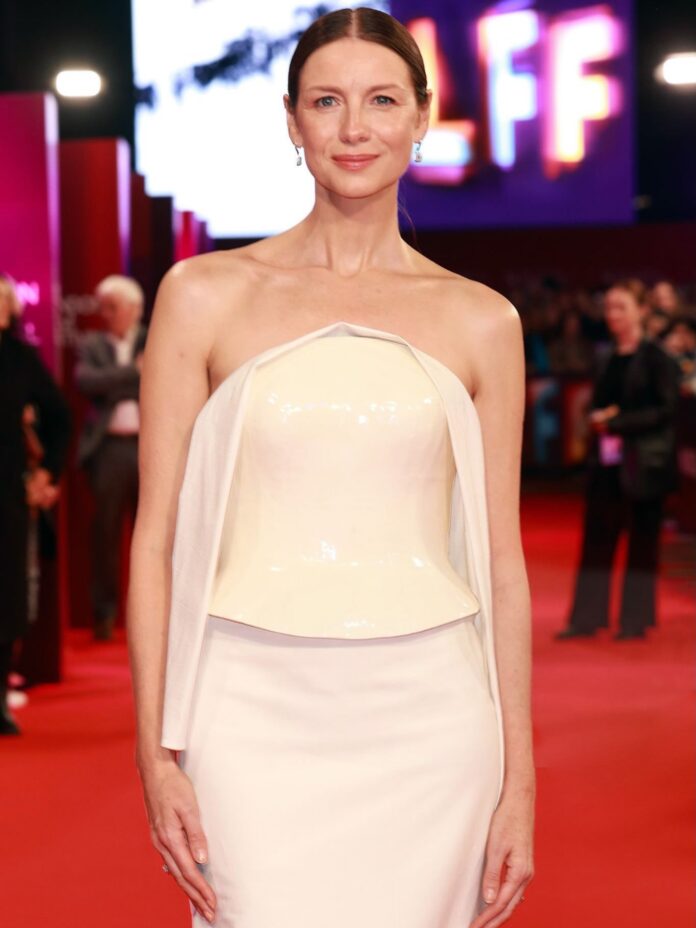
We returned to The Royal Festival Hall on London’s South Bank for the BFI London Film Festival welcomed the UK Premiere of A Long Winter, Andrew Haigh’s windswept, deeply felt drama set high in the Colorado Rockies. The film stars Fred Hechinger, Ebon Moss-Bachrach, Caitríona Balfe, Kit Connor, D’Pharaoh Woon-A-Tai, Manuel Garcia-Rulfo and David Furr; it was written and directed by Andrew Haigh, adapted from the short story by Colm Tóibín.
A Long Winter will be released in UK cinemas on 15th January 2027.
Colin Hart and Abigail Shii were on the red carpet, here are their interviews.
A Long Winter BFI London Film Festival UK Premiere Interviews
There are performances that challenge an actor’s abilities, and then there are roles that reach somewhere much deeper, touching emotions and experiences that audiences may recognize in their own lives. For Caitríona Balfe, her work in A Long Winter became something profoundly personal, not simply because of the character she portrays, but because of the painful truth she discovered at the heart of Louise’s story. In her red-carpet interview at the London Film Festival premiere, the Outlander star opened up about her admiration for director Andrew Haigh, the emotional complexity of Louise, and the women of an earlier generation who struggled without the support or language to explain what they were going through. Her reflections reveal why this role stayed with her long after filming ended—and how a remote mountain setting became much more than a beautiful backdrop.
A role that began with admiration for Andrew Haigh
For Balfe, the opportunity to work with Andrew Haigh had been a long time coming. She explained that she had wanted to collaborate with the filmmaker for years, making the arrival of the script especially exciting. When her agent contacted her with the screenplay and soundtrack, she was already eager to discover what the project had to offer.
Yet the material itself was what ultimately drew her in. Balfe spoke warmly about Haigh’s distinctive approach to storytelling, particularly his empathy and sensitivity toward the people he puts on screen. Rather than judging characters for their mistakes or reducing them to a single defining struggle, his work gives their experiences room to breathe. He recognizes that suffering exists on different scales: some people face devastating battles that reshape their lives, while others experience quieter forms of pain that can be just as difficult to articulate.
That sensitivity was crucial to Balfe’s understanding of Louise. The character’s addiction and personal struggles are central to her story, but Balfe’s interpretation reaches beyond the obvious difficulties. She sees a woman whose circumstances have gradually narrowed her world, leaving her feeling trapped in a life from which escape seems increasingly impossible.
Why Louise became so special to Caitríona Balfe
One of the most revealing moments in the interview came when Balfe explained why she felt such a strong connection to Louise. She was careful to distinguish her own life from the character’s circumstances, acknowledging that she had never experienced the same situation. Nevertheless, she recognized something universal in Louise’s emotional reality: the experience of feeling stuck, powerless, or unable to find a way forward.
This distinction is important. Balfe does not suggest that every person can fully understand addiction or the particular hardships Louise faces. Instead, she identifies a shared emotional starting point—the moments when life feels overwhelming and the tools needed to change it seem out of reach. By finding that common ground, she can approach Louise with compassion without minimizing the severity of her struggles.
Balfe also recognizes that people today may have greater access to resources, support systems, and language that help them understand difficult experiences. Those tools are not equally available to everyone, and they were often far more limited for women of earlier generations. For Louise, that absence becomes part of the tragedy.
The actress’s most poignant reflection concerns how many women from that generation may have suffered in silence. Without the words to explain their pain, or the support to help them escape destructive circumstances, their struggles could remain hidden until they became overwhelming. Balfe’s response was not simply to sympathize with Louise, but to develop a deep affection for her.
“I just fell in love with her,” she said, describing the character as someone very special to her.
It is a simple statement, but it captures the emotional foundation of her performance. Balfe did not approach Louise as a collection of problems to be portrayed convincingly. She sought to understand the person behind those problems: her limitations, her loneliness, and the human needs that remain even when life has become unbearably difficult.
The cabin and mountains that helped tell Louise’s story
Balfe’s interview also offers a fascinating glimpse into how the film’s physical environment shaped her performance. The production’s cabin, costumes, and remote mountain setting were not merely visual details designed to make the film look authentic. They helped her inhabit Louise’s world in a tangible, everyday way.
Before filming began, Balfe spent time in Louise’s kitchen, rearranging its contents according to how she imagined the character would organize her home. She wanted to know where everything belonged and why it belonged there. That process might sound like a small practical exercise, but for an actor, it can make an enormous difference.
A character’s life is often communicated through ordinary routines rather than dramatic speeches. Knowing where a cup is kept, where a familiar utensil can be found, or how a room is arranged gives an actor a sense of ownership over the space. Instead of having to think about where to reach for something, the actor can respond instinctively, allowing the character’s habits to emerge naturally.
For Balfe, the kitchen became a particularly meaningful place from which to understand Louise’s circumstances. Standing at the sink and looking out toward the harsh landscape, she could begin to feel the psychological weight of the mountains surrounding the house.
The environment was not simply isolated; it seemed to press in on the character. Balfe described the mountains as looming over Louise, creating a sense of being crushed by their constant presence. Even inside the cabin, the wind could be heard, and the house itself creaked under its force.
These details helped establish an atmosphere in which the outside world was never entirely absent. The mountains followed Louise into her domestic life, transforming the cabin from a refuge into a space where the burden of isolation remained palpable.
When the landscape becomes part of the character
The relationship between setting and psychology is one of the most compelling ideas to emerge from Balfe’s comments. In a conventional film, mountains and snow might provide visual grandeur, danger, or a dramatic contrast to the warmth of a home. In A Long Winter, as Balfe describes it, the landscape also helps communicate an internal condition.
Louise’s surroundings give physical form to the feeling of being trapped. The mountains are enormous, indifferent, and impossible to ignore. The cabin offers shelter from the weather, but it cannot necessarily protect her from the emotional pressures of her life. The result is a setting that reflects her predicament without needing to explain it directly.
Balfe’s preparation demonstrates how carefully considered physical details can support an emotionally complex performance. Rearranging a kitchen might seem insignificant compared with learning lines or rehearsing a difficult scene, yet it allowed her to build a believable relationship with Louise’s home. That familiarity made the surrounding hostility more powerful: the character had a domestic world of her own, but that world existed within a landscape that seemed to overwhelm it.
The production conditions also appear to have contributed to the atmosphere. Balfe recalled the wind intensifying as the crew reached the mountain location, with its force audible even from inside the house. Such experiences can give actors a sensory understanding of a scene that cannot be fully recreated through imagination alone.
The environment did not replace emotional preparation. Instead, it reinforced it, providing a constant reminder of the pressures Louise faced.
More than another snowy film for the Outlander star
During the conversation, the interviewer joked about the recurring presence of snow on posters for Balfe’s recent projects, teasing that the actress seemed to be having a mountain-themed run of roles. Balfe responded in good humor, even suggesting that she would happily welcome a change of scenery—perhaps a beach rather than another snowy landscape.
The lighthearted exchange offered a contrast to the seriousness of her reflections on Louise. It also highlighted an important distinction: while the film’s wintry setting may be an immediately recognizable part of its visual identity, the story’s emotional substance is what made the experience meaningful to Balfe.
Her comments suggest that the role was not defined simply by the challenges of filming in a remote location or by the physical demands of working in harsh conditions. What mattered most was the opportunity to understand a woman whose suffering reflected broader questions about isolation, addiction, and the consequences of living without adequate support.
Balfe’s affection for Louise also reflects the kind of character work that can resonate beyond a single film. Audiences do not necessarily need to share a character’s exact circumstances to recognize the feelings underneath them. The fear of being stuck, the difficulty of asking for help, and the loneliness of believing that nobody truly understands are experiences that can cross generations.
By approaching Louise with empathy rather than judgment, Balfe invites viewers to look beyond the character’s struggles and consider the person experiencing them.
The deeper meaning behind Balfe’s connection to Louise
Ultimately, the most powerful aspect of Balfe’s interview is her insistence on seeing Louise as a human being rather than a symbol of addiction or despair. Her reflections on earlier generations of women add another layer to that understanding, raising questions about how many lives might have unfolded differently if support, understanding, and the ability to speak openly about suffering had been more accessible.
Her preparation for the role was equally revealing. She built a relationship with Louise’s home, learned its routines, and allowed the mountain landscape to shape her understanding of the character’s emotional confinement. These choices show how performance can emerge from the interaction between an actor’s imagination, the physical world of a production, and a willingness to look closely at another person’s pain.
For Balfe, Louise became special because she was someone worth understanding, even when her life was difficult to comprehend. That may be the most important insight from the interview: empathy does not require pretending that another person’s experiences are identical to our own. It requires the willingness to listen, to look beyond appearances, and to recognize the humanity that remains beneath the struggle.
And perhaps that is why Balfe’s words linger. The mountains may dominate the landscape of A Long Winter, but the real weight of the story lies in the life of the woman standing beneath them—and in the compassion the actress found while trying to understand her.