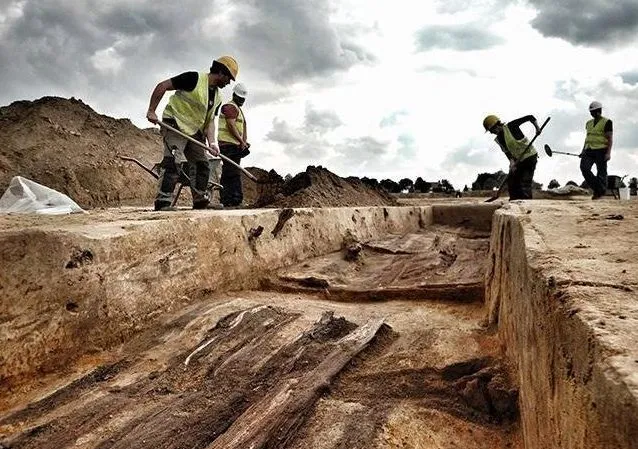
SKELETONS of 125 World War One soldiers have been found entombed in a perfectly preserved battlefield 101 years after they fell in combat, it emerged today.
Archaeologists uncovered the remains of the troops, their weapons and even their toothbrushes and bottles of HP sauce in an elaborate web of trenches in a village near the city Ypres in Flanders.

The complex network of fighting and communication trenches was first uncovered in 2015 by archaeologists brought in to examine a field due to be built on as part of a housing development.
Now after painstaking work on the site in Wijtschate, the horrors that unfolded on an area the size of two football pitches has been laid bare.
Most of the men, who were German, British, French and South African, were found where they fell, with most being killed during the First Battle of Ypres in 1914.
Other skeletal remains were buried in mass graves alongside religious artefacts placed there by their comrades.


The First Battle of Ypres

The First Battle of Ypres took place on the Western Front in Belgium from October 19 to November 22, 1914.
Advancing German troops attempted to break through the defending British and French lines.
In one of the Great War’s bloodiest conflicts, 58,155 allied soldiers were killed while 46,765 Germans died in the space of a month.
Germany failed to breach the allied defences and dug themselves in, marking the beginning of the entrenched stalemate that would mire troops for the rest of the conflict.
The archaeological site was known to the allies as Hill 80 and was held by the Germans until June 1917 when it was taken by British and Irish troops during the Battle of Messines.
The Germans re-took the hill in 1918.


Experts believe about 100 of the dead are German.
The others are British, South African and French troops.
All were shot dead or killed by shell fire or shrapnel during the First Battle of Ypres in November 1914 – one of the World War One’s first battles.
Some appear to be not to be fully grown men and its thought these lads could have been as young as 15.


Some of their remains were later pulverised by the artillery bombardment from their own side.
As well as bodies, the team of British, German and Belgian archaeologists and historians have also found thousands of poignant personal effects of the men.
These include helmets, rifles, ammunition, searchlights, water bottles, cooking utensils, coffee pots, watches, cap badges, toothbrushes and even a bottle of HP sauce and a tin of Andrews Liver Salts.
Recovered religious relics include crucifixes, rosary beads and a statue of Mary Magdalene.

Some of these were found in the German mass graves and highlight the strong religious beliefs held by the Bavarian soldiers who died there in 1914.
It is the biggest mass grave found on the Western Front since 250 bodies were uncovered at Fromelles in France 2009.
The unique and historic excavation project, called Dig Hill 80, started in the spring of this year following a hugely successful crowdfunding campaign that raised over £150,000 to finance it.

The relevant authorities, such as the Commonwealth War Graves Commission, have been notified of the finds and the difficult task of identifying the dead has begun.
It is hoped some of them men can be buried with full military honours in marked graves.
Professor Peter Doyle, the lead archaeologist for Dig Hill 80, said: “When you look at these mass graves and think of these young men, you know they had a mother and father who missed them.
“Yet they have never been given peace.
“In some village in Bavaria for example, there maybe a war memorial with their name on.
“Now everyone of these men have the chance of being taken from this site and given a respectful burial with full military honours.”

Prof Doyle, said: “We removed all of the top soil to allow us to see what was beneath.
“All trenches and bomb craters were thoroughly searched and all the remains were mapped, photographed and catalogued.
“All of the bodies have now been recovered. We didn’t want to leave a man behind.
“Some of these German soldiers killed in action were dragged into this mass grave and buried by their comrades while they fought to hold the line.
“The men were buried in uniforms and with their helmets. Not a lot of the uniform fabric has preserved, just fabric around the buttons.
“But the skeletal remains have been preserved intact. By looking at them you can tell they are young men.
“We have casualties who were killed and left in that position where the ground around them has been pulverised by shell fire, we are looking at fragments of soldiers.
“It brings home the sheer intensity of the shell fire.”


Further donations are now required to fund the identification and repatriation process of the dead soldiers.
Al Murray said: “A true project of cooperation, I believe this excavation is of utmost archaeological and historical significance.
“I would encourage people to donate and help restore dignity to the missing soldiers of Wijtschate, before it is too late.”